Tradeshow CMPX

2026 ASPE Convention & Expo

Date
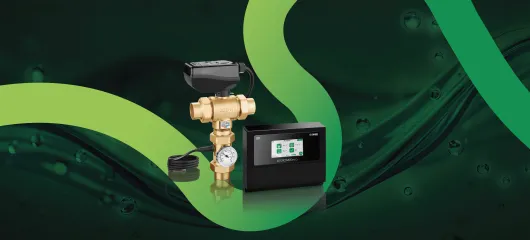
From Booth 2001, Designing Without the Risk: Caleffi Introduces LEGIOMIX®evo
LEGIOMIXevo

Beyond automated Legionella control, Caleffi’s next-generation digital mixing valve eliminates scale buildup, temperature spikes, emergency scalding risks during power outages, and compliance risks that threaten commercial hot water systems.

MILWAUKEE, WIS. – [August 5, 2026]  – Specifying domestic hot water (DHW) systems for hospitals, schools, and senior care facilities requires balancing strict health department mandates with real-world mechanical reliability. While facility owners focus on safety management, installers face a broader set of operational risks: What happens to occupant safety during a power loss? What if hard water scale seizes the valve? What if the Building Management System (BMS) connection is lost?

Addressing these Domestic Hot Water vulnerabilities, Caleffi North America launched the LEGIOMIXevo, a next-generation digital mixing platform designed to eliminate mechanical failure, ensure continuous compliance, and give total specification confidence.

Building on more than 20 years of global engineering and field-proven performance with the original LEGIOMIX® series, the evo elevates commercial DHW management to adapt to a range of healthcare and institutional design goals to operate the intended water plan.

"We engineered the LEGIOMIXevo so specifiers don't have to piece together separate safeguards. It handles pathogen management effortlessly, but more importantly, it protects the system as a whole against physical and operational risk," said Jake Hicks, Senior Product Manager at Caleffi North America. “Our goal with the LEGIOMIXevo isn't just to sell a mixing valve; it's to act as a partner in water safety. We designed this valve to make compliance automatic, documentation transparent, and system fail-safe protection so engineers can specify with absolute confidence.” 
 

Evo Description

Multi-Layered Protection Against System Risk

Simple Commissioning: Equipped with a full-color touchscreen interface, allowing field engineers and technicians to configure parameters, adjust setpoints, and review historical logs without requiring specialized software or laptops.

Fail-safe Operational Protection: Offers configurable safety options, including a fail-safe actuator, emergency high-temperature water shut-off, and dedicated relays to ensure hot water never leaves the mechanical room above setpoint, even during complete power loss.

Automated Scale Management: Scale accumulation leads to inconsistent operation and premature valve failure. The evo features an automated self-cleaning sequence that performs a full rotation to wipe clear mineral deposits nightly, maintaining precise temperature without causing system downtime or expensive rebuild kits.

Standalone Datalogging: Equipped with native BACnet IP, Modbus, and optional Caleffi Cloud connectivity. Crucially, if the facility's BMS loses connection, the evo controller continues to log temperature data across all sensor locations, ensuring no data gaps.

Streamlined Retrofit & Installation: Available as a standalone valve assembly or pre-piped and pre-wired on a modular unistrut station, significantly cutting down mechanical room footprint and installation time.

Caleffi will showcase the LEGIOMIXevo live at the 2026 ASPE Convention & Expo in Oklahoma City, booth #2001, from October 12-13.

Technical Expertise Educational Session 
Domestic Hot Water Recirculation in High-Rise Buildings
Presented by Jake Hicks, Cody Mack, and Kayla Redding
Wednesday, October 14 | 11:30 a.m. – 12:45 p.m.
Well-designed domestic hot water recirculation loops are essential for sustainable, energy-efficient, and low-maintenance
plumbing systems. High-rise construction complicates these objectives, particularly when managing recirculation across different
pressure zones. To exceed performance goals, engineers must precisely select and apply pressure-reducing valves, point-of-distribution mixing valves, and balancing valves. 
This session will:
• Analyze pressure-reduction zones
• Discuss point-of-distribution mixing
• Detail balancing strategies